What Would the World Look Like if Economists Were in Charge? (Ep. 3)

Pretend for a moment that our highest elected officials, instead of acting like the lawyers that they are, were replaced by economists. You’ll hear from the economists Steve Levitt and Russ Roberts, former Estonian prime minister Mart Laar, and from a grandson of Milton Friedman about this supposedly rosy future.
We’ve just released the third episode of our Freakonomics Radio podcast (here at iTunes; RSS feed here; listen to the transcript; or listen live via the box at right), and this one strikes close to the heart of many readers. It asks a simple speculative question: What would the world look like if economists were in charge?
You’ll hear a bit from Steve Levitt about the economist’s worldview in general, and how it differs from the politician’s. You’ll also hear from the very insightful Russ Roberts, a professor of economics at George Mason University who also blogs, has a podcast of his own, writes books, and produces rap videos. Here’s a cut of Roberts’s interview:
Finja por un momento que nuestros más altos funcionarios electos, en lugar de actuar como los abogados que son, fueron reemplazados por economistas. Usted escuchará de los economistas Steve Levitt y Russ Roberts, el ex primer ministro estonio Mart Laar, y de un nieto de Milton Friedman sobre este futuro supuestamente prometedor.
Acabamos de lanzar el tercer episodio de nuestro podcast Freakonomics Radio (aquí en iTunes; fuente RSS aquí; escuche la transcripción; o escuche en vivo a través del cuadro de la derecha), y este llega al corazón de muchos lectores. Hace una simple pregunta especulativa: ¿Cómo sería el mundo si los economistas estuvieran a cargo?
Escuchará un poco de Steve Levitt sobre la visión del mundo del economista en general, y cómo difiere de la del político. También escuchará al muy perspicaz Russ Roberts, profesor de economía de la Universidad George Mason que también escribe en su blog, tiene un podcast propio, escribe libros y produce videos de rap. Aquí hay un corte de la entrevista de Roberts:
Finja por un momento que nuestros más altos funcionarios electos, en lugar de actuar como los abogados que son, fueron reemplazados por economistas. Usted escuchará de los economistas Steve Levitt y Russ Roberts, el ex primer ministro estonio Mart Laar, y de un nieto de Milton Friedman sobre este futuro supuestamente prometedor.
Acabamos de lanzar el tercer episodio de nuestro podcast Freakonomics Radio (aquí en iTunes; fuente RSS aquí; escuche la transcripción; o escuche en vivo a través del cuadro de la derecha), y este llega al corazón de muchos lectores. Hace una simple pregunta especulativa: ¿Cómo sería el mundo si los economistas estuvieran a cargo?
Escuchará un poco de Steve Levitt sobre la visión del mundo del economista en general, y cómo difiere de la del político. También escuchará al muy perspicaz Russ Roberts, profesor de economía de la Universidad George Mason que también escribe en su blog, tiene un podcast propio, escribe libros y produce videos de rap. Aquí hay un corte de la entrevista de Roberts:
SJD: Okay, let’s play a fantasy game for a minute and pretend that you, Russ Roberts, a creative and very bright economist come to Washington and are put in charge of the whole country. And unlike every other economist that’s ever gone to high office, you don’t start acting like a politician. You really act like an economist from day one. So you get there, you’re behind the desk, you’ve got a pen and paper. What are some of the first things you do as soon as you arrive?RR: I’m getting goose bumps, it’s so exciting. Well, what I would do? Let’s start with some obvious things. I would get rid of the Department of Commerce. The Department of Commerce doesn’t do anything except subsidize exports, which is just a way of saying it makes certain companies rich at the expense of the rest of us. So I don’t think the Department of Commerce does anything particularly useful, I would get rid of that. I’d get rid of the Department of Education. I don’t think that the Federal Government has any productive role to play in the school system. I’d get rid of all tariffs. I’d let people be free to buy whatever they wanted from all around the world. What else? I would get rid of the minimum wage law, which I think makes it hard for low-skilled people to find work; it makes them artificially expensive. I’d change the Federal Reserve. We spend a lot of time trying to find the right interest rate. That’s a fool’s game that has contributed to the current crisis. So I would change the Federal Reserve. I would certainly at a minimum require it to only care about price stability. Right now it cares about price stability, unemployment, the health of the stock market, Wall Street salaries, evidently. So I would get all of those things out. It’s going to be hard to do legislatively, so I would probably replace the the Fed with a Friedmanite fixed growth and money supply or just abolish it entirely and let private money emerge. I’m getting out of control here.
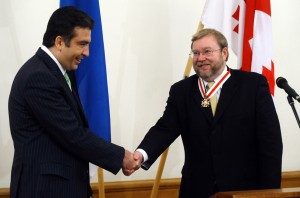
Kudos to former Estonian prime minister Mart Laar. Photo by Raigo Pajula/AFP/Getty Images)
The program also features an interview with Mart Laar, a two-term prime minister of Estonia who has been widely credited with turning a downtrodden former Soviet republic into a “Baltic Tiger.” How did this happen? As Laar tells it, he essentially channeled the spirit of Milton Friedman:
ML: First of all, when you grow up and develop under the Communists, then first of all you see what is not working, and that means that the Communism is not working and all those left-wing socialist ideas of state control and so on, they are just not working. They are against the human nature, and they will fail. Which means that when you read the Soviet newspapers about one man who is especially dangerous, especially crazy, and absolutely mad, and we should destroy all the human beings and the economies and so on, and this man was called Milton Friedman. And of course I became interested and when I first read Milton Friedman, it was my first book on economy that I ever have read. Then of course I was very interested because I think most of the ideas were simple but here they looked like work. And when I became the prime minister I decided, Why not.
You will hear an interesting story about Laar introducing the flat tax, a Friedman favorite, to Estonia, and about Laar’s meeting with Margaret Thatcher, whereupon he learned that the flat tax was not as commonly applied as he thought.
You’ll also hear from Friedman’s own grandson, Patri Friedman, whose personal belief is that the U.S. government is such a sclerotic oligarchy that the best solution is to start a new civilization in the ocean. That’s what led to his founding the Seasteading Institute. Here’s a look at a couple of possible seasteading options:

Photo: seastading.org Exterior of Clubstead, a 200-guest hotel/resort designed “to withstand the waves off the coast of California.”

seastading.org Personality Winner of the Seastead Design Contest.
And finally, this being Freakonomics, you’ll also hear from Allie, the high-end call girl featured in SuperFreakonomics, talking about what her business would look like if the economists took over and legalized prostitution — along with drugs like marijuana and cocaine, and a market for human organs …
Hope you enjoy.


Dan Dan
Mario Bros. Mario Bros.
Michael K Michael K
Ken Conocer
Who determines what is "good and bad" Quién determina qué es "bueno y malo"
Will Será
The most interesting parts of economics I find are about market failures. Las partes más interesantes de la economía que encuentro son sobre fallas del mercado.
Bryan Bryan
Dan Dan
nate nate
http://dts.podtrac.nytimes.com/redirect.mp3/podcasts.nytimes.com/podcasts/2010/03/23/23freakonomicsradio.mp3 http://dts.podtrac.nytimes.com/redirect.mp3/podcasts.nytimes.com/podcasts/2010/03/23/23freakonomicsradio.mp3
iTunes is awful. iTunes es horrible
PaulD PaulD
Of course, it does: it can implement a nationwide voucher system so that parents can choose how to educate their own children no matter where they live (without paying for said education twice). Por supuesto que sí: puede implementar un sistema de cupones a nivel nacional para que los padres puedan elegir cómo educar a sus propios hijos sin importar dónde vivan (sin pagar dos veces por dicha educación).
DT DT
nate nate
Like science and medicine, economics requires rules, editors to follow them, and some kind of public accountability, or it becomes an echo chamber. Al igual que la ciencia y la medicina, la economía requiere reglas, que los editores las sigan y algún tipo de responsabilidad pública, o se convierte en una cámara de eco.
Brad Warbiany Brad Warbiany
Michael R. Keller Michael R. Keller
In the game, the end result of having a taken-to-the-extreme libertarian society was . En el juego, el resultado final de tener una sociedad libertaria llevada al extremo fue. . . . . not pleasant. no es agradable.
Grant Conceder
Lori Lori
I'm pretty sure Bioshock went badly because people got addicted to chemicals from a sea slug that let them create ADAM that warped people's brains. Estoy bastante seguro de que Bioshock salió mal porque las personas se volvieron adictas a los químicos de una babosa de mar que les permitió crear ADAM que deformaba los cerebros de las personas. I suppose you could attribute the mass spread of ADAM to the lack of rules surrounding commerce, but economic analysis, particularly new institutional economics shows that you don't need a strong DoC to regulate people's behaviors in small settings. Supongo que podría atribuir la difusión masiva de ADAM a la falta de reglas que rodean el comercio, pero el análisis económico, particularmente la nueva economía institucional muestra que no necesita un DoC fuerte para regular el comportamiento de las personas en entornos pequeños. I wouldn't try to use a Bioshock argument as a reason to not have a libertarian society, the same way I wouldn't use a 1984 argument to justify total anarchy. No trataría de usar un argumento de Bioshock como una razón para no tener una sociedad libertaria, de la misma manera que no usaría un argumento de 1984 para justificar la anarquía total. I have an econ major (admittedly with a Randian bent) and have played Bioshock- not the best analogy. Tengo un econ major (ciertamente con una inclinación randiana) y he jugado Bioshock, no es la mejor analogía.
Weirror Weirror
Ed Ed
johnleemk johnleemk
One issue with that is although market failures are *interesting*, it is their relative uncommonness which makes them interesting. Un problema con eso es que aunque las fallas del mercado son * interesantes *, es su relativa falta de comunión lo que los hace interesantes. Markets obviously fail all the time -- but they only fail critically in a handful of cases. Los mercados obviamente fallan todo el tiempo, pero solo fallan críticamente en un puñado de casos. In the vast majority of cases, it's unimaginable to not have a market. En la gran mayoría de los casos, es inimaginable no tener un mercado. Nobody could imagine buying their food or clothes from one central provider. Nadie podía imaginar comprar su comida o ropa de un proveedor central. Most of the things people have are obtained from relatively well-functioning markets. La mayoría de las cosas que las personas tienen se obtienen de mercados que funcionan relativamente bien.
It's common belief that markets don't work perfectly. Es una creencia común que los mercados no funcionan perfectamente. What's less commonly understood is that despite this, they often work well enough. Lo que se entiende menos comúnmente es que a pesar de esto, a menudo funcionan lo suficientemente bien. Since in most of the cases studied by economists, markets are working, obviously cases of market non-failure are going to be more prevalent than cases of market failure. Dado que en la mayoría de los casos estudiados por los economistas, los mercados funcionan, obviamente, los casos de falta de mercado serán más frecuentes que los casos de falla del mercado.
Grant: Conceder:
That's a common misconception. Ese es un error común. Economists are pretty unanimous on issues like rent control, for example. Los economistas son bastante unánimes en temas como el control de alquileres, por ejemplo. The consensus among healthcare economists is for a healthcare system which doesn't exist in most developed countries (one with government intervention, but a different kind than the one typically envisioned). El consenso entre los economistas de la salud es para un sistema de salud que no existe en la mayoría de los países desarrollados (uno con intervención del gobierno, pero un tipo diferente al que normalmente se imagina).
Disagreements are interesting because they can get very public and brutal (academia being what it is), but no media outlet is ever going to carry the boring story, "AEA members agree: tariffs are generally bad." Los desacuerdos son interesantes porque pueden volverse muy públicos y brutales (la academia es lo que es), pero ningún medio de comunicación va a llevar la aburrida historia: "Los miembros de la AEA están de acuerdo: los aranceles son generalmente malos".
John John
Like children in a sandbox building impossible skyscrapers in their mind, these little fantasies of being king show a healthy imagination. Como los niños en un cajón de arena construyendo rascacielos imposibles en su mente, estas pequeñas fantasías de ser rey muestran una imaginación saludable. Nothing wrong with that. Nada de malo con eso. But they also direct our gaze to the vast, black, silent, void between the world we stand on and the world in the economists mind. Pero también dirigen nuestra mirada al vasto, negro, silencioso, vacío entre el mundo en el que nos encontramos y el mundo en la mente de los economistas.
Can we also have some centaurs in our world, please, oh king? ¿Podemos también tener algunos centauros en nuestro mundo, por favor, oh rey?
John John
It could only end in tragic violence. Solo podría terminar en violencia trágica.